Brush Clearing After Logging: Control Scotch Broom & Blackberries
Learn how to safely clear Scotch broom and blackberries after logging while protecting young trees and reducing fire risk on your acreage.
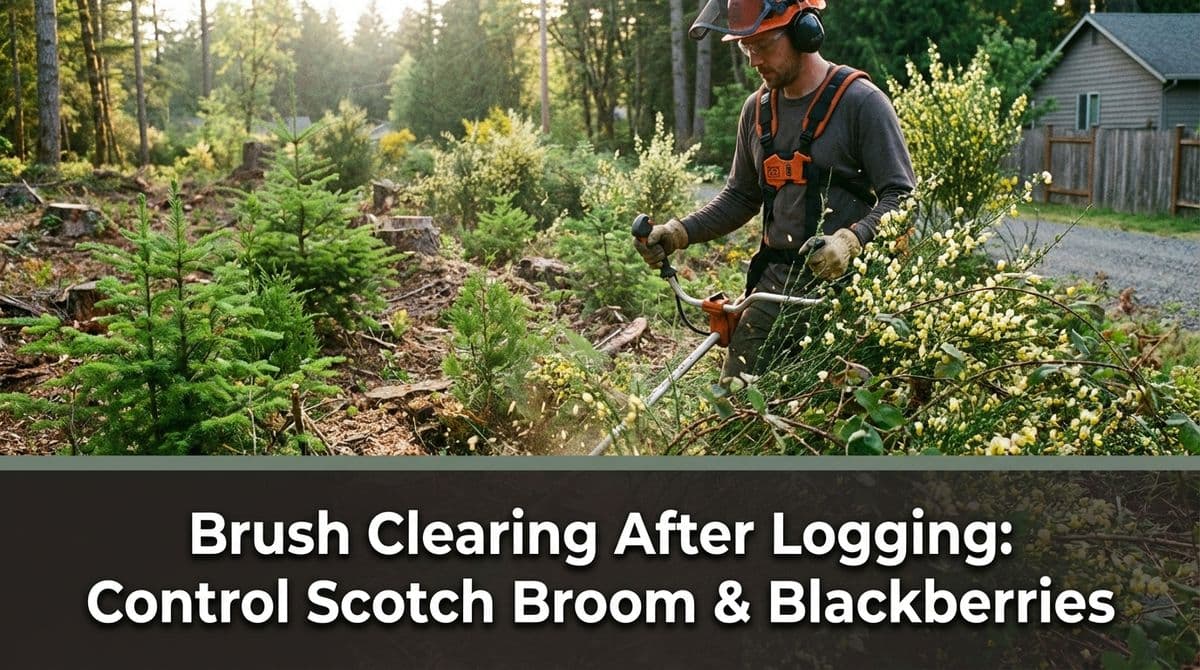
Clearing Scotch Broom and Blackberries After Logging
We recently got a call from a landowner — let's call him Tom — who owns just under 10 acres that were logged about ten years ago. The logging was necessary because of root rot in some big old trees, but after the equipment left, the site was never fully cleaned up.
Over the years, Scotch broom and Himalayan blackberries took over the upper part of his property. Now, young firs and maples are finally coming up through the mess, but the brush is so thick that walking through it sounds “like popcorn” from all the dry seed pods snapping. Tom told us what really keeps him up at night: in the summer, that dried-out broom “just turns into tinder,” and he’s worried one careless cigarette or firework from the road could start a wildfire.
His question to us was simple: “Can you clear out the Scotch broom and blackberries, work around the stumps, and protect the young trees I want to keep?” The answer is yes — and this is exactly the kind of brush clearing project we handle all the time.
Why Post-Logging Brush Grows So Fast
When a property is logged and not fully cleaned up, nature doesn’t just sit still. Disturbed soil, leftover stumps, extra sunlight, and a bit of time are the perfect recipe for aggressive plants like Scotch broom and Himalayan blackberries.
Here’s what usually happens, just like on Tom’s land:
- Full sun hits the forest floor after logging, which invasive plants love.
- Seed banks that have been sitting in the soil for years suddenly germinate.
- Scotch broom fixes nitrogen, helping it outcompete young native trees.
- Blackberries form thick, thorny mats that smother seedlings and make access nearly impossible.
Meanwhile, the young firs and volunteer maples you do want are trying to grow through all of that competition. If you don’t step in, the invasives usually win.
The Fire Risk from Scotch Broom and Blackberries
Tom’s biggest concern was fire risk, and he’s absolutely right to worry.
Scotch broom is especially dangerous in dry months because:
- It dries out and becomes extremely flammable “ladder fuel.”
- Its dense stands help fire travel quickly across a slope.
- Dead stems and seed pods crackle and pop when you walk through — a sure sign of how dry they are.
Himalayan blackberries don’t look as dangerous when green, but the old canes build up a surprising amount of dry mass at ground level. Combined, they create a thick, continuous fuel bed. On a semi-flat property with some hills and banks — like Tom described — that can be a serious problem, especially along roads.
Our Approach: Mulching While Protecting Young Trees
Tom wanted to knock the brush down, protect the young firs popping up, and keep many of the maples he liked the look of. He also still had big stumps scattered across the upper five acres. His concern was whether we could “pick and choose” around the good trees and work around the stumps safely.
Here’s how we typically approach a project like his:
- Site walk-through first. We walk the property with you and mark the trees you definitely want to keep (flagging tape is great for this).
- Identify hazards. We note slopes, banks, large stumps, wet spots, and access routes for equipment.
- Bring in a forestry mulcher. This equipment can grind Scotch broom and blackberry canes down to near ground level, turning them into mulch.
- Work around stumps and desired trees. An experienced operator can maneuver around old stumps and “weave” between young firs and volunteer maples.
- Two-pass strategy. One pass to open everything up and see what’s really there, then a second pass to knock remaining brush down to a more manageable level.
With Tom, we talked about what a typical day with a mulcher looks like and how long a heavily brushed 8–10 acre property might take. In many cases like his, you’re looking at two to three days, with the first day focused on opening up access and the next days fine-tuning and cleaning up.
How Much Clearing Do You Really Need?
Another smart point Tom raised was whether it was worth going all the way to full stump removal on the upper portion of his property. He doesn’t plan on developing it or turning it into a “golf course ready” pasture anytime soon — his goal is control, safety, and preserving his family land for the next generation.
That’s a common fork in the road for landowners, and our general advice is:
- Start with brush control. Knock down Scotch broom and blackberries and see what you have.
- Preserve what you like. Keep the young conifers and broadleaf trees you want for shade, privacy, or habitat.
- Decide on stumps later. Once the property is opened up, you can better judge whether full stump removal, replanting, or light thinning makes sense.
On long-held family properties like Tom’s, it often makes the most sense to stabilize the land and reduce fire risk first, then make bigger decisions over time.
Tips for Homeowners Managing Post-Logging Brush
If you’re in a similar situation — you had logging done years ago and now you’re buried in Scotch broom and blackberries — here are some practical steps:
- Walk the property in late summer. That’s when fire risk is highest and you can really hear and feel how dry the brush is.
- Flag trees to save. Before any equipment comes in, mark the young trees and maples you want to keep.
- Focus first 50–100 feet from roads and structures. Reducing fuel loads near access points and buildings has the biggest impact on safety.
- Plan for follow-up. Scotch broom and blackberries will try to come back. A maintenance pass every couple of years can keep them from taking over again.
- Consider your long-term plan. Are you keeping it as forest, pasture, or just open space? Your end goal should guide how aggressive the clearing needs to be.
Need Help Taming Your Logged Acreage?
Whether your property is a multi-generational family place like Tom’s or a new piece of land you’ve just bought, you don’t have to let Scotch broom and blackberries run the show. With the right equipment and a careful, selective approach, we can reduce fire risk, protect your young trees, and make the land manageable again — without turning it into a moonscape.
If you’d like us to take a look at your property, we can walk it with you, talk through your goals, and give you a clear estimate based on the acreage, terrain, and density of brush. From there, you can decide how far you want to go — from basic knock-down to near “golf-ready” clearing.
Your land doesn’t have to be perfect; it just has to be safe, healthy, and something you’re proud to pass on.