Land Clearing & Site Leveling Costs for New Home Builds
Buying a lot to build on? Learn what really affects land clearing and site leveling costs so you can choose the right property and avoid budget surprises.
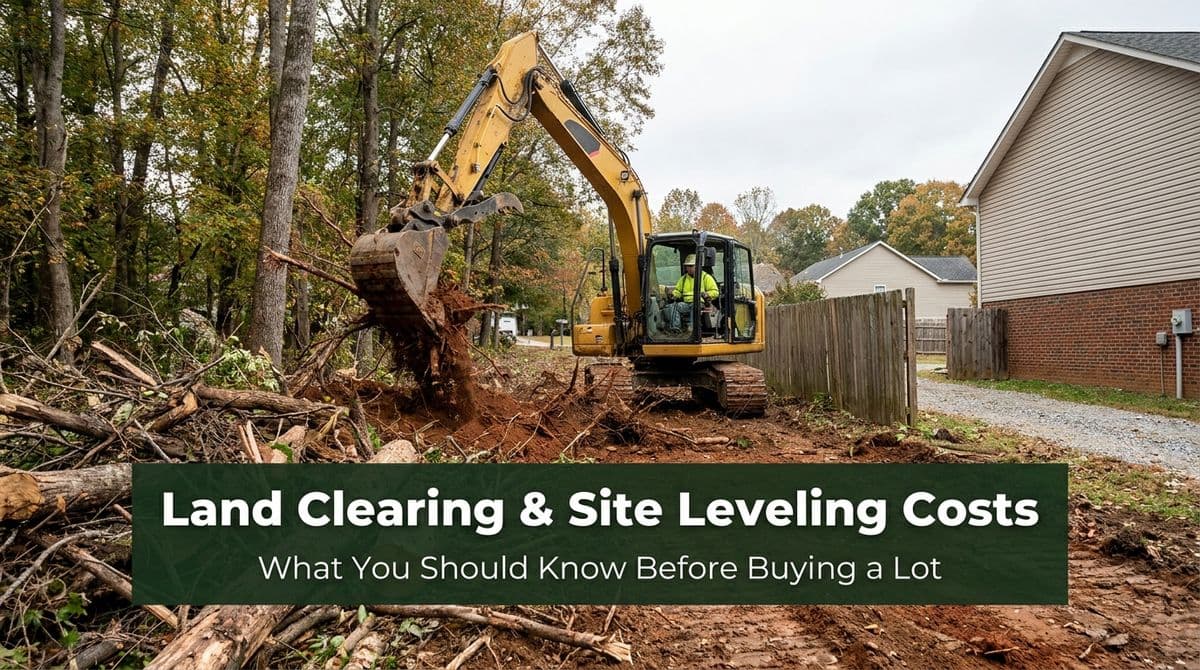
Thinking About Buying a Lot? Read This Before You Fall in Love With the View
We recently got a call from a homeowner — let’s call him Matt — who was eyeing two side-by-side lots and dreaming about building two homes: one on each parcel. Before signing on the dotted line, Matt wanted to know, “What’s it going to cost to clear and level these for building?”
He hadn’t purchased the land yet, which, honestly, is the smart way to do it. The two lots were each around 7,800 square feet, one of them noticeably more sloped than the other. He was trying to decide whether to buy both lots or just one, and he suspected (correctly) that land clearing and site leveling costs could be the tiebreaker.
Calls like Matt’s are exactly why we often offer to swing by a property and take a look before people buy. On paper, two lots can look almost identical. On the ground, one might be a straightforward project and the other a small mountain of hidden costs.
Why a “Ballpark Price” Is So Hard Without Seeing the Lot
When Matt asked for a quote, the first things we wanted to know were:
- How dense is the brush and tree cover?
- How steep and uneven is the lot (especially that second, more sloped parcel)?
- Is he planning a full clearing for building pads or just light underbrush clearing?
On a listing, you might see “vacant land” and a square footage. That doesn’t tell you:
- Whether you’re dealing with a few small trees or a mini-forest
- If there are stumps, rocks, or old fill buried under the surface
- How much cut-and-fill (earth moving) it will take to create a level building site
That’s why, like we told Matt, we’ll often pull the listing, then drive by to get eyes on the terrain. A 15–20 minute site visit can make the difference between a wild guess and a realistic estimate.
The Main Factors That Affect Land Clearing Costs
If you’re comparing potential building lots, here’s what has the biggest impact on cost to clear:
1. Density and Type of Vegetation
Light underbrush vs. full clearing is a big price difference. For example:
- Light brush, blackberries, saplings: Quick machine clearing, lower cost.
- Large trees and stumps: More time, heavier equipment, higher disposal or chipping costs.
- Mixed forest: Some trees may be preserved, but maneuvering equipment around them adds time.
Tip: When you walk a lot, look down more than you look up. Stumps, thick roots, and big downed logs often tell the real story.
2. Slope and Overall Terrain
Matt mentioned that one of his lots was “a little more sloped.” That’s a red flag for potential grading costs. Even a modest slope can mean:
- More excavation and hauling
- Retaining walls or stepped foundations
- Extra compaction work to make a stable building pad
Two lots can be the same size, but the flatter one may cost significantly less to prepare for a home. If your budget is tight, the flattest buildable lot often wins, even if it’s not the prettiest.
3. Access for Equipment
We also look at how we’re going to get in and out with machines and trucks:
- Is there an existing driveway or is access blocked by trees or a ditch?
- Is the road wide enough for equipment and dump trucks?
- Will we need temporary access, mats, or road base?
Good access keeps costs down. Tight, tricky access usually means smaller equipment and more time.
4. Debris Handling and Disposal
Clearing is only half the job. The other half is deciding what to do with the material:
- Chipping on-site: Often cheaper; chips can be used for erosion control or paths.
- Hauling off-site: More expensive but leaves a much cleaner pad.
- Burning (where allowed): Can be cost-effective but comes with permits, timing, and smoke considerations.
Let your contractor know your long-term plans. If you want a tidy, build-ready pad right away, we’ll plan the clearing and disposal differently than if you’re okay with a “rough cleared” site for a while.
Land Clearing vs. Site Leveling: They’re Not the Same
Matt’s goal, like many future homeowners, was to “clear some land and level it out in order to build.” Those are really two separate phases:
Phase 1: Land Clearing
That’s the removal of:
- Brush, blackberries, and small trees
- Larger trees and stumps (as needed)
- Surface rocks and obvious debris
The result is a visible, accessible property where you and your builder can actually see what you’re working with.
Phase 2: Site Leveling and Grading
Once we can see the ground, we focus on:
- Creating a level pad for the home and driveway
- Managing drainage so water moves away from the house
- Meeting the builder’s foundation and elevation requirements
With sloped lots like Matt’s second parcel, grading can be a bigger line item than the initial clearing. That’s why it’s key to talk about your exact build plan (one house vs. two, garage location, driveway option, etc.) before we quote the work.
What You Should Do Before You Buy a Lot
If you’re in the same spot Matt was — trying to decide whether to buy a lot (or two) for a future home — here’s a simple checklist:
- Walk the property in person. Pictures and listings rarely show slope, stumps, or access issues accurately.
- Bring a builder or site contractor early. A quick walk-through can reveal big cost differences between lots.
- Ask about utilities and drainage. Where will water go? How far are power, water, and sewer or septic?
- Check local rules. Some areas have restrictions on tree removal, grading, or fill import/export.
- Get a rough site-prep estimate before you commit. The “cheaper” lot can become the expensive one once you add clearing, grading, and access.
When Matt called, he was doing exactly the right thing: running the numbers on land prep before committing to buy. Whether you’re looking at a quarter-acre in town or a few acres out of town, getting professional eyes on the property early can save you from nasty surprises later.
If you’re staring at a listing and wondering what it would really cost to clear and level it for a new home, reach out. We’re always happy to take a look, talk through options, and help you decide which lot makes the most sense for your budget and your build.