Mulching Slopes: Mini-Excavator Mulchers vs Skid Steers
Got a brushy, sloped yard that feels like “Jumanji”? Here’s when a mini-excavator mulcher is safer and smarter than a skid steer for clearing hillsides.
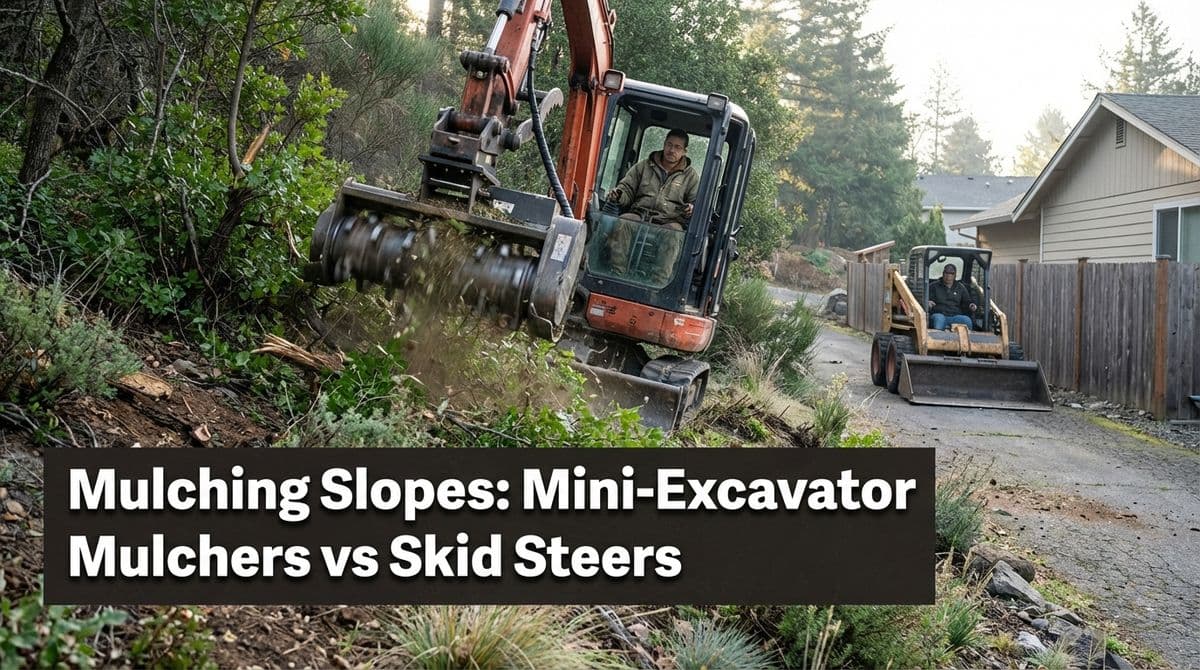
Mulching a “Jumanji” Hillside: Why We Reached for the Mini-Excavator
We recently got a call from a homeowner — let’s call him Mark — who was trying to tame what he jokingly called his “Jumanji” side yard. He wanted to clear a long, overgrown strip along the side of his property so he could eventually level it out and install a shed.
The tricky part? That side yard wasn’t flat. It sloped up away from the house, and the vegetation had gotten thick. Mark had already realized a skid steer would struggle on that incline and told us, “It’d be hard to put a skid steer on there with the way the land is.” He was exactly right — which is why we told him we’d bring our mulcher mounted on a mini-excavator instead.
As we pulled up mapping tools while we were still on the phone with him, we could see the slope, the neighboring subdivision, and even some wetter ground farther back on the property. All of that pointed to the same solution: a mini-excavator mulcher instead of a skid steer.
What Is a Mini-Excavator Mulcher, Anyway?
When most people think of land clearing, they picture a big skid steer with a mulching head blasting through brush. That can be a great setup on flatter, more open ground. But on slopes, near property lines, or close to structures, a different tool often works better.
A mini-excavator mulcher is simply a compact excavator with a mulching head attached to the boom instead of a bucket. That boom can reach out, up, and down without the machine itself having to sit right on top of whatever we’re clearing.
That gives us a few key advantages:
- Better reach: We can sit in a safer, more level spot and reach up the slope or down into dips.
- More precise control: The boom lets us “surgically” mulch around fences, trees you want to keep, and property lines.
- Improved stability on slopes: A tracked mini-excavator can work on inclines where a skid steer would be pushed to its limits.
Mini-Excavator vs. Skid Steer on Slopes
Mark’s main concern was the steepness of his side yard. He knew driving a skid steer up and down that incline would feel sketchy, and we agreed. On slopes, we think about three things: traction, center of gravity, and escape routes.
Why Mini-Excavators Shine on Hillsides
Here’s how a mini-excavator mulcher typically wins out over a skid steer on slopes:
- Lower center of gravity: Excavators are designed to sit stable while reaching with the boom. We can keep the machine on the most stable part of the slope and let the boom do the reaching.
- Tracks and “planting” the machine: We can position the excavator, square up the tracks, and sometimes use the blade for extra stability.
- Safer working angles: Instead of driving up and down the hill, we often work across it from a safer position.
Skid steers are fantastic on flatter ground — they’re quick, nimble, and powerful. But they need to be on or very near what they’re mulching. On a steep hillside like Mark’s, that means the whole machine is constantly perched on uneven, sloped terrain. That’s where the mini-excavator has a clear safety and control advantage.
When a Mini-Excavator Mulcher Is the Better Choice
We don’t automatically choose an excavator for every job. Sometimes a skid steer is still the most efficient. But here are situations where we usually recommend the excavator-mounted mulcher:
- Sloped or rolling ground: Side yards, drainage swales, ravines, and hillside lots.
- Narrow access along property lines: Like Mark’s strip along the neighboring subdivision.
- Obstacles to work around: Fences, sheds, septic systems, trees you want to keep, or utilities.
- Soft or wet areas further back: We can stay on the firmer ground and reach out with the boom to avoid getting a heavy machine stuck.
On Mark’s project, the goal wasn’t to clear all two-plus acres. He just wanted that “Jumanji” strip opened up so he could see what he was working with and plan for grading and shed placement. That’s exactly the kind of targeted clearing where a mini-excavator mulcher shines.
How We Plan a Slope Mulching Job
Before we bring equipment out, we walk through a few questions with every homeowner, just like we did with Mark:
- What’s the end goal? Shed pad, view, fire break, or just general cleanup?
- Where does it actually need to be cleared? We define the exact area so we’re not doing unnecessary work.
- What’s the terrain like? Slope, wet spots, and access points all affect our equipment choice.
- What needs to stay? Trees, fences, survey markers, and utilities get flagged or marked.
For Mark, we reviewed maps together, confirmed there was a good turnaround for our truck and trailer, and talked about how far back he wanted us to go. We also paid attention to the wetter areas he mentioned farther into the property so we could avoid tearing up soft ground.
How Homeowners Can Prepare for a Mulching Visit
If you’re thinking about a similar project, there are a few simple things you can do before we arrive to keep the job smooth and efficient:
Access, Parking, and Pets
- Clear the driveway and parking area: Make sure there’s room for a truck and trailer to pull in and turn around, just like Mark’s wide cul-de-sac.
- Unlock gates: Any gates we’ll need to pass through should be unlocked or accessible.
- Secure pets and kids: Curious pets and children should be inside or in a safe area away from the work zone while equipment is running.
Marking Boundaries and Hazards
- Mark the “do not touch” areas: Use flagging tape, stakes, or paint to show us trees, shrubs, or structures you definitely want to keep.
- Point out utilities: Tell us about any known septic tanks, drain fields, water lines, or buried utilities in the area.
- Walk the slope with us: A quick walk-through together at the start helps align expectations and confirm the game plan.
Budgeting and Estimating Costs for Slope Mulching
One of the first questions we usually hear is, “What’s this going to cost?” While every property is different, a few factors tend to move the needle:
- Size of the area: A narrow strip along a fence will cost less than clearing every hillside on a multi-acre parcel.
- Density of growth: Light brush and blackberries go faster than large saplings and heavy undergrowth.
- Slope and access: Steeper slopes, tight access, or obstacles can slow production slightly compared to wide-open ground.
- Disposal needs: Most mulching jobs leave material on-site as a shredded mulch layer. If you need debris hauled out, that adds cost.
For many slope jobs, we price by the day or half-day rather than by square foot, because terrain and vegetation can change quickly across the property. During an on-site visit — like the one we scheduled with Mark later that same day — we walk the area, talk through your goals, and give you a clear estimate before any work begins.
Do You Need Permits for Slope Clearing?
Permit requirements vary by area, but there are a few general guidelines we encourage homeowners to consider:
- Check local rules: Some jurisdictions have special rules for clearing near streams, wetlands, or steep slopes.
- Watch for protected trees: Larger trees or certain species may be protected and require permission to remove.
- Stay within your plan: If your property is part of a subdivision or HOA, review any guidelines on tree removal or screening between neighbors.
We’re always happy to talk through what you’re planning and point you toward the right local resources so you don’t run into surprises after the fact.
Thinking About Tackling Your Own “Jumanji” Slope?
If you’re staring at an overgrown hillside and wondering how to start, you’re not alone. Mark’s situation is one we see all the time: a sloped side yard, a clear long-term goal (in his case, a shed), and a wall of brush in the way.
A mini-excavator with a mulcher attachment is often the safest, most controlled way to clear that kind of ground, especially when skid steers start to feel like they’re on the edge of what’s safe. With the right equipment and a thoughtful plan, we can turn that “Jumanji” jungle into a clean, usable space and give you a clear view of your next steps for grading, drainage, and building.
If you have a slope that needs taming, we’re always glad to walk it with you, talk through your goals, and recommend whether a mini-excavator mulcher, skid steer, or a mix of tools is the best fit.