How We Reclaim Overgrown Acreage from Invasive Blackberries
Learn how our team reclaims overgrown rural acreage from invasive blackberries with safe clearing strategies, equipment options, and long-term management tips.
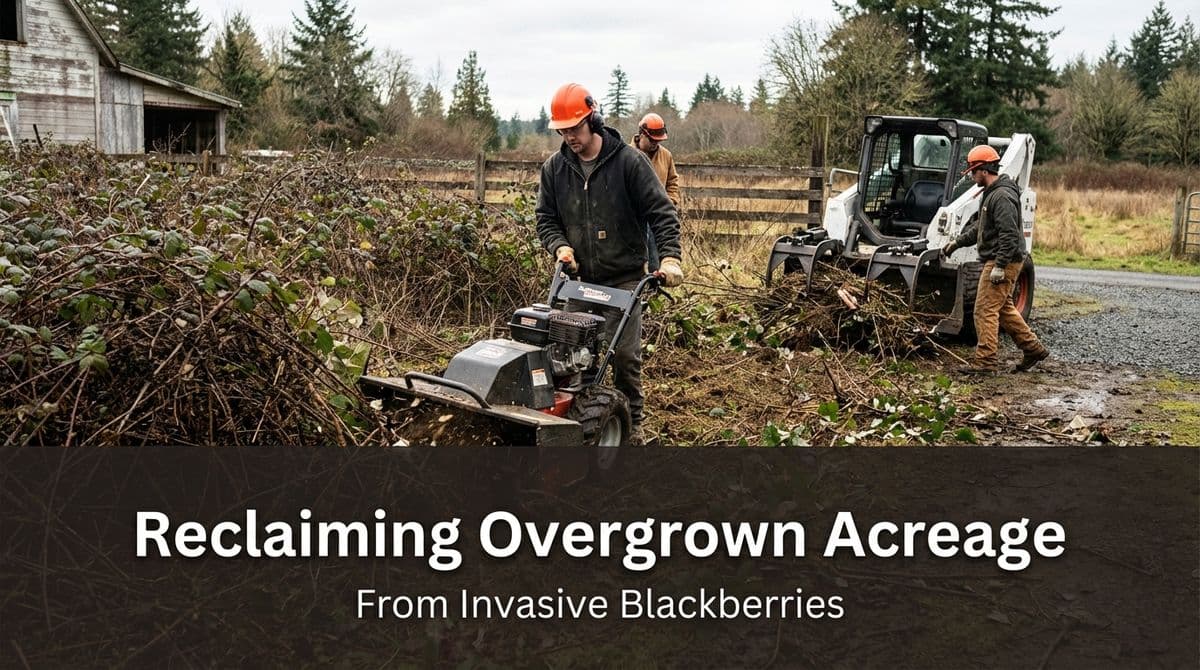
When Blackberries Take Over: A Two-Acre Rescue Story
We recently got a call from a customer — let's call her Sarah — who owns a small farm and wedding venue on about 20 acres. She told us she had “lost control” of roughly two acres of Himalayan blackberries that had swallowed fence lines, tree rows, and the edges of a slough. She’d tried a brush hog and a weed eater blade, but there were places she just couldn’t reach safely or effectively.
Her situation is one we see all the time on rural properties: the blackberries are winning the battle, and owners are exhausted from trying to fight back with hand tools. So we walked her through a practical strategy to reclaim the land now and keep it manageable long term — without damaging the nearby waterway or her patch of cultivated blueberries.
In this post, we’ll share the same approach we use on properties like Sarah’s so you can plan your own blackberry reclaim project with clear expectations, the right equipment, and a realistic maintenance plan.
Step 1: Walk the Site and Map Your Blackberry Zones
Before we talk about equipment or herbicides, we always start with a site assessment. With Sarah, we asked for wide-angle photos and a screenshot of her property map with the blackberry areas roughly outlined.
For your own acreage, we recommend doing a simple “blackberry map” walk:
- Note the terrain: Is it fairly level, sloped, or full of hidden dips and hummocks?
- Check for water: Are there ditches, creeks, wetlands, or a slough nearby? Are any areas still soggy or seasonally flooded?
- Mark valuables: Flag desirable plants (like Sarah’s blueberries), young trees, irrigation lines, and structures you want to protect.
- Assess access: Where can a truck, trailer, or tractor safely get in and turn around?
This walk-through helps determine what equipment can safely be used, where we need to switch to hand tools, and whether there are any environmental restrictions near waterways that we need to respect.
Step 2: Choose the Right Equipment for Different Areas
Sarah could reach part of her field with a brush hog, but it simply wasn’t the right tool for tight tree lines and the steep drop toward the slough. That’s common — one piece of equipment rarely fits the whole property.
For open, fairly level fields
On big, open patches of blackberry, we typically use:
- Skid steer or compact track loader with a heavy-duty brush mower or mulcher head to grind canes down to near soil level.
- Tractor with a brush hog if access is good and the ground is reasonably smooth.
These machines let us cover large acreage quickly and convert a 6–10 foot tall blackberry wall into a low, shredded layer in a day or two, depending on size.
For tree lines, fence lines, and tight spots
In the treed edges of Sarah’s property, we recommended smaller and more precise methods:
- Walk-behind brush mowers for narrow corridors where larger equipment can’t safely turn.
- Clearing saws or heavy-duty blade trimmers where roots and stumps are mixed with canes.
- Selective hand cutting around blueberries, young ornamentals, or native shrubs.
We always plan to leave “islands” of desirable plants, just like Sarah’s blueberry patch, and clear around them by hand if needed.
Near water, sloughs, and wet areas
One of the first questions we asked Sarah was whether there was standing water. Motorized equipment in or near a slough or wetland is often restricted, and it’s simply not safe when the ground is soft.
Near water we typically:
- Stay off the banks with heavy equipment to avoid erosion and bank collapse.
- Use hand tools and targeted cutting on the upper edges of the slope.
- Check local regulations if herbicides are being considered, since many products are not allowed near waterways.
If you’re unsure about your local rules, your county conservation district or extension office is a great place to start. They can advise on buffer zones, permitted products, and best practices.
Step 3: Safety First — Blackberries Hide Surprises
When we talked with Sarah, she mentioned the previous owner had been there for 30 years and she’d been “throwing things away” for two years. That’s a red flag for buried debris.
Before we take any mower into tall blackberry, our team makes a safety sweep:
- Look for trash and metal: Fencing, wire, old gates, buckets, and equipment can be hidden under the canes.
- Watch for uneven ground: Old irrigation ditches, animal burrows, and sinkholes can roll or tip smaller machines.
- Plan escape routes: If you’re operating equipment yourself, always know where you can safely back out.
If you’re doing any of this work on your own, we strongly recommend:
- Heavy clothing and gloves (blackberries are unforgiving).
- Eye and ear protection with power equipment.
- Sturdy boots with good ankle support.
Half the battle is simply getting the canes down to ground level safely. Once that first pass is complete, maintenance becomes much more manageable.
Step 4: Plan for Regrowth and Long-Term Control
After we walked through strategy with Sarah, we emphasized something most landowners underestimate: one big clearing pass is not the end of the story. Blackberries will come back; the goal is to weaken them over time and favor what you want to grow instead.
A simple maintenance calendar
Here’s a basic maintenance rhythm we often suggest for rural properties, which we shared with Sarah as she looked ahead to wedding season and planting her farm:
- Late winter–early spring: Major mechanical clearing while the ground is firm and before rapid spring growth. This is the ideal time for that first big push.
- Late spring: Walk the cleared areas and cut any new shoot clusters. Young canes are easier to handle and haven’t re-armed themselves yet.
- Mid–late summer: Mow or brush cut regrowth if accessible. If you’re using herbicides as part of your plan, late summer to early fall is often when plants are pulling energy back to the roots, making treatments more effective. Follow label directions and local regulations carefully, especially near water.
- Fall: Overseed with grass or plant competitive groundcovers in high-traffic or visible areas to occupy the space and shade out new blackberry seedlings.
Outcompete the blackberries
Long-term success usually involves planting something you do want in those reclaimed areas. For a property like Sarah’s, that might mean:
- Pasture grasses for livestock.
- Meadow mixes or low-maintenance grass for a wedding venue backdrop.
- Native shrubs and trees in buffer zones near the slough.
Regular mowing of those new plantings keeps blackberry seedlings from establishing a new foothold.
When to Call in a Professional Crew
Sarah realized she’d reached the limit of what pruners and a weed eater blade could do on two acres of mature blackberry. That’s usually the point where bringing in a crew with the right machines saves months (and sometimes years) of effort.
You might want to call in help if:
- The blackberries are taller than you and thick with old canes.
- There’s more than about half an acre to clear.
- The ground is rough, steep, or near water, and you’re unsure what equipment is safe.
- You’re on a deadline — like Sarah’s mid-May wedding season — and need it done in one concentrated push.
On projects like hers, we often do the site walk and the majority of the clearing in a single visit, then leave the owner with a simple maintenance plan so the blackberries never get that kind of head start again.
If your acreage feels like it’s being taken back by invasive blackberries, you’re not alone. With a clear strategy, the right mix of equipment and hand work, and a realistic maintenance schedule, you can reclaim those overgrown acres and keep them usable for the long haul.